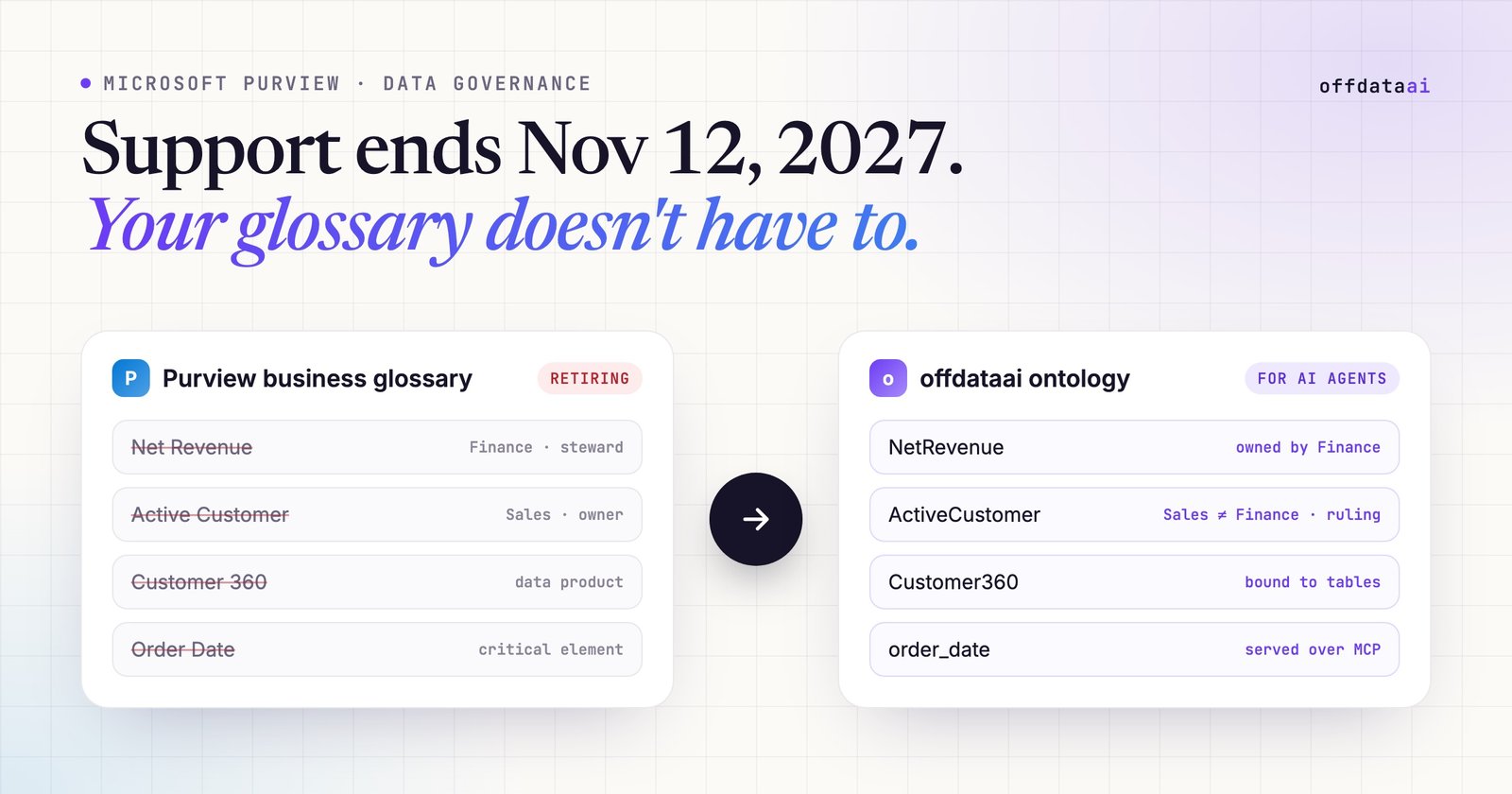
Databricks Unity Catalog governs data and AI assets inside Databricks: it controls who can access which catalogs, schemas, tables, volumes, functions and models, and records lineage between them. Microsoft Purview was built for governance across the whole estate (scanning many sources, a business glossary and data products) plus data security and compliance. Since Microsoft's November 2026 announcement that Purview Data Governance will be retired, with support ending on November 12, 2027, the comparison has changed: Purview is focusing on security and compliance, and Microsoft is moving estate-wide governance to the OneLake catalog in Microsoft Fabric.
Side by side
| Unity Catalog | Microsoft Purview | |
|---|---|---|
| Main job | Access control, discovery and lineage for Databricks data and AI | Data security and compliance; estate-wide governance (being retired, see below) |
| Scope | Databricks workspaces, plus external locations and federated sources | Microsoft 365, Azure, Fabric and connected third-party sources |
| Access control | Enforced: GRANT on catalogs, schemas, tables, row filters, column masks | Policies and sensitivity labels; enforcement depends on the source |
| Lineage | Automatic, column-level, for workloads run on Databricks | Collected from scans and connectors |
| Business glossary | Comments, tags and metric views; no full glossary product | Glossary terms, business domains and data products in the Unified Catalog |
| Open source | Unity Catalog OSS project available | No |
The Purview Data Governance retirement
Microsoft announced that support for Purview Data Governance ends on November 12, 2027, with governance of the data estate moving to the OneLake catalog in Fabric, and Purview continuing for classification, labelling, data loss prevention and compliance. If your team built a glossary, data products or critical data elements in Purview, plan where they go. Our Purview Data Governance retirement guide covers what was announced and how to migrate a glossary.
Which should you use?
- Databricks is your main platform: Unity Catalog is required for modern Databricks features and should be your access-control layer.
- You run Azure Databricks alongside Fabric and Microsoft 365: use Unity Catalog for Databricks data, Purview for sensitivity labels and compliance, and plan the glossary's move away from Purview Data Governance.
- You need one business glossary across platforms: neither tool alone covers it well now. Keep definitions in a platform-neutral place and publish them to each platform, for example as Unity Catalog metric views and comments.
Unity Catalog alternatives
For access control inside Databricks there isn't a real alternative; Unity Catalog is the platform's governance layer. For the wider jobs (discovery across platforms, glossary, ontology and AI context), teams pair it with a catalog or governance tool such as Atlan, Alation, Collibra or Informatica, or with a model-first tool like offdataai. See our Unity Catalog comparison.
Frequently asked questions
Can Purview scan Unity Catalog?
Purview has offered connectors for Azure Databricks and Unity Catalog metadata. Given the Purview Data Governance retirement, check Microsoft's current roadmap before building on it.
Is Unity Catalog a data catalog?
Yes, for Databricks: it lists and governs every asset there and supports search and lineage. It is not designed as an estate-wide catalog for other platforms' native assets.
What replaces Purview Data Governance?
Microsoft points customers to the OneLake catalog in Fabric, and to partner tools for specialist governance needs.
Move your glossary somewhere portable
offdataai imports a Purview glossary into an ontology, binds terms to real tables in Databricks, Snowflake, BigQuery or Postgres, and publishes them to Databricks as metric views. See Purview migration.