
Unity Catalog and offdataai — meaning beyond one platform
Unity Catalog metric views and Genie give Databricks a strong home for business meaning, inside Databricks. offdataai keeps the model and its definitions platform-neutral, validates them, and publishes them to Databricks as metric views as well as to any agent over MCP.
- From $1/month
- 8 SQL targets
- 174 templates
1connect databricks · unity catalog read · 42 tables2ontology sales v5 (released)3 Net revenue sum(order_line.amount) - refunds ruling: finance4 Active customer ordered in last 90 days56publish metric view main.semantic.sales_metrics7serve mcp: ask_ontology → runs on databricks8 row filters applied · email masked9export ossie.json · ontology.ttl
Databricks Unity Catalog and offdataai, compared
| Databricks Unity Catalog | offdataai | |
|---|---|---|
| Where definitions live | Unity Catalog metric views in your Databricks workspace | An offdataai ontology, versioned with draft and release, published to Databricks as metric views and exportable as Apache Ossie, OWL or JSON-LD |
| Defining metrics | SQL DDL or Catalog Explorer with a YAML spec: measures, dimensions, joins, window measures, parameters | Concepts, relations and metrics bound to the data model, with team-scoped meanings and a ruling when definitions conflict |
| Who uses them | SQL editors, notebooks, dashboards, Genie and alerts, plus external BI tools such as Power BI, Tableau and Sigma | Any MCP agent (17 tools) and the REST API; dbt through the Apache Ossie export; Databricks through published metric views |
| Warehouses | Databricks | Designs for 8 platforms; reads live schemas from Postgres, MySQL, Snowflake, BigQuery, Redshift and Databricks; runs queries on Postgres, Redshift and Databricks |
| The physical model | Governs the tables, views and volumes you create | Designs the model first (AI interview, templates, canvas) and generates Databricks DDL, a dbt project and migrations |
| Context for agents | Genie Agents configured with datasets, sample queries, instructions, metrics and verified answers | Concept search, join paths, ask_ontology and run_query over MCP, under row filters and PII masking, with the SQL each agent ran |
| Openness | Unity Catalog itself is open source (Apache 2.0, LF AI & Data Foundation) | Definitions export as an Apache Ossie semantic model, OWL and JSON-LD |
Which one fits your team
Choose Databricks Unity Catalog when
- Your analytics, dashboards and AI assistants all live in Databricks, and Genie is the agent your people use.
- Your Databricks team wants to author metric views directly in SQL or Catalog Explorer.
- You want governance of tables, volumes, models and functions in one catalog for the lakehouse.
Choose offdataai when
- You run more than one warehouse, or might, and want definitions that aren't tied to one platform.
- Agents outside Databricks, such as Claude, Cursor or your own, need the same definitions under row filters and PII masking.
- You want the data model and its meaning designed and validated together, with team-scoped definitions and rulings, before tables are built.
Define once in offdataai, publish to Unity Catalog
offdataai works with Databricks rather than around it. Design the model, define and release the metrics, then publish them to Databricks as metric views. The same released definitions serve MCP agents and export as Apache Ossie for other tools.
- 01
Design the model or read your Unity Catalog schema live.
- 02
Generate Databricks DDL and a dbt project, published to Git.
- 03
Define concepts and metrics, settle conflicts with a ruling, release.
- 04
Publish a metric view to Databricks and serve the same context over MCP.
See it in action
A narrated walkthrough, recorded in the real app.
Three steps, minutes not months
Describe or import
Answer a short interview, open a template, draw on the canvas or connect a live database.
Review a validated model
Keys, grain, history and PII are checked before any code is written. Refine it in plain English.
Ship and keep it current
Native DDL, dbt, seeds, docs and an ontology. Push to Git, diff versions, generate migrations.
Why teams choose offdataai
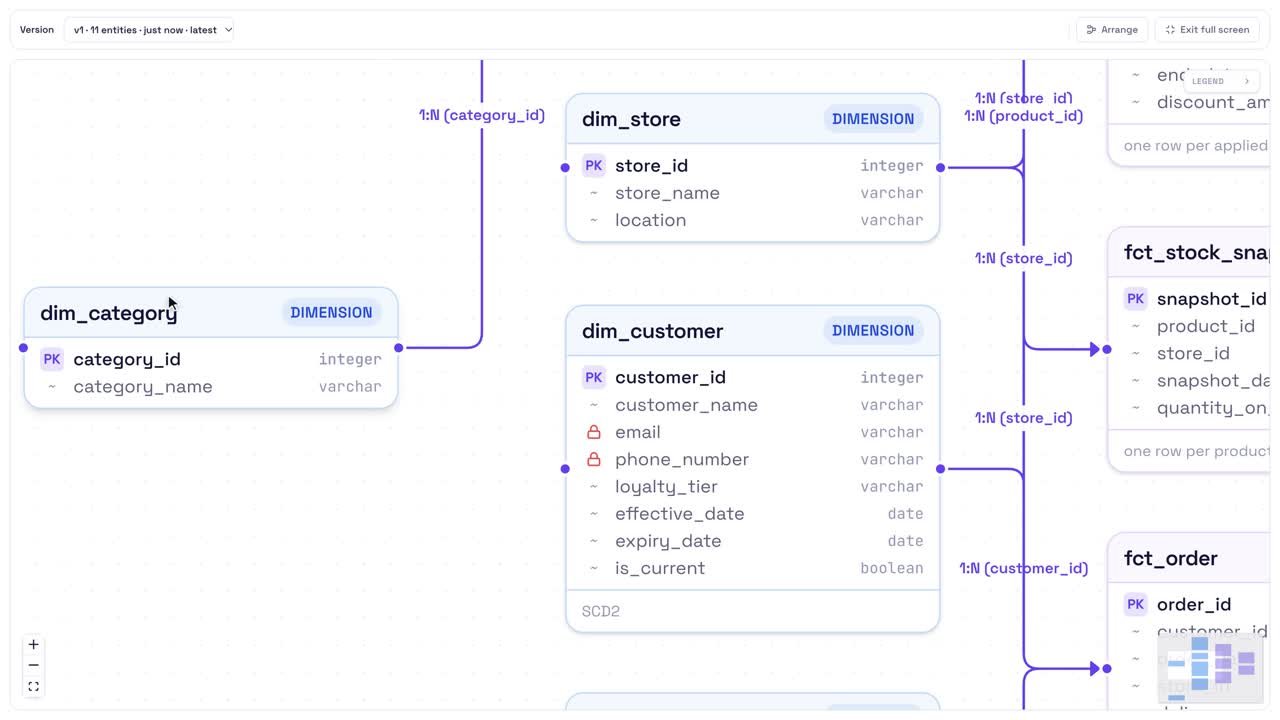
A validated ERD: keys, SCD2 history and PII flags on every table
- 01
Warehouse platforms are adding semantics because AI answers depend on them.
- 02
Databricks does it well with Unity Catalog metric views and Genie: define a metric once, then group it by any dimension, in any Databricks tool.
- 03
The trade-off is location.
- 04
Definitions authored in one platform live in that platform. offdataai keeps your business logic with your business: the model, metrics and team definitions are designed and validated in one place, published to Databricks when you want them there, and served to every other agent and warehouse from the same source.
How offdataai works with Databricks
Live Unity Catalog reads
Connect a workspace and read catalogs, schemas, tables and columns into an editable model.
Databricks DDL and dbt
Generate Databricks DDL, a full dbt project and migrations from the validated model, and publish to Git.
Metric view publish
Turn released offdataai metrics into a Databricks metric view.
Queries on Databricks
ask_ontology and run_query execute on Databricks, compiled from released definitions, under access rules.
Portable definitions
The same ontology exports as Apache Ossie, OWL and JSON-LD, and generates SQL for seven other platforms.
0
Validated templates
0
SQL targets
0
Modeling paradigms
0+
Industries covered
Generates native SQL and dbt for 8 platforms · connects live to Snowflake, Databricks, BigQuery, Redshift and Postgres
 RedshiftPostgreSQL
 Synapse
 FabricDuckDB
 dbtSnowflakeBigQueryDatabricksRedshiftPostgreSQLSynapseFabricDuckDBdbt
Frequently asked questions
Does offdataai replace Unity Catalog?
If we already use metric views, why add offdataai?
How does offdataai publish to Databricks?
What if we move some workloads off Databricks later?
Can agents query Databricks through offdataai?
More comparisons
- Atlan vs offdataaiAtlan builds context from the assets you already have. offdataai captures meaning when the model is designed, validates it and serves it to agents.
- SqlDBM vs offdataaiBoth are cloud modelers. offdataai starts from a conversation or a template and treats meaning, validation and agent access as the core, in open formats.
- dbt Semantic Layer vs offdataaidbt is where transformations and metrics-as-code live. offdataai designs the model and its meaning upstream, then hands dbt a project and an Apache Ossie semantic model.
- Power BI semantic models vs offdataaiPower BI semantic models serve Power BI reports well. offdataai keeps business definitions outside any one BI tool, for every agent and warehouse.
- All comparisonsCatalogs, modelers, warehouse semantics and BI models, side by side.
- Databricks schema generatorDatabricks DDL, dbt and metric views from one model.
Part of the offdataai platform
The business context behind accurate AI answers, built from the data model up.
- 01DesignLogical, physical and dimensional models.
- 02GenerateSQL, dbt, documentation and migrations.
- 03DefineBusiness metrics, semantic models and ontology.
- 04ConnectReal warehouse schemas and metadata.
- 05GovernDrift, impact analysis, tests and approvals.
- 06ActivateMake trusted context available to AI agents.
This page covers Generate and Connect. Every stage works on the same model, so what you design here carries through to the rest.
Give your AI agents context they can trust.
Design the model, define what your metrics mean, and serve that context to every agent and BI tool, on the warehouse you already run.
Databricks, Unity Catalog and Genie are trademarks of Databricks, Inc. offdataai is not affiliated with or endorsed by Databricks. Comparison based on Databricks' public documentation as of November 2026.