
Data modeling tools in 2026 — and where AI fits
Desktop modelers, diagram tools, code-first frameworks and AI-native platforms all call themselves data modeling tools. Here is what each category does well, and when offdataai is the better fit.
- From $1/month
- 8 SQL targets
- 174 templates
"entities": 11,
"grain": "line",
✓ validated
See it in action
A narrated walkthrough, recorded in the real app.
Three steps, minutes not months
Describe or import
Answer a short interview, open a template, draw on the canvas or connect a live database.
Review a validated model
Keys, grain, history and PII are checked before any code is written. Refine it in plain English.
Ship and keep it current
Native DDL, dbt, seeds, docs and an ontology. Push to Git, diff versions, generate migrations.
Why teams choose offdataai
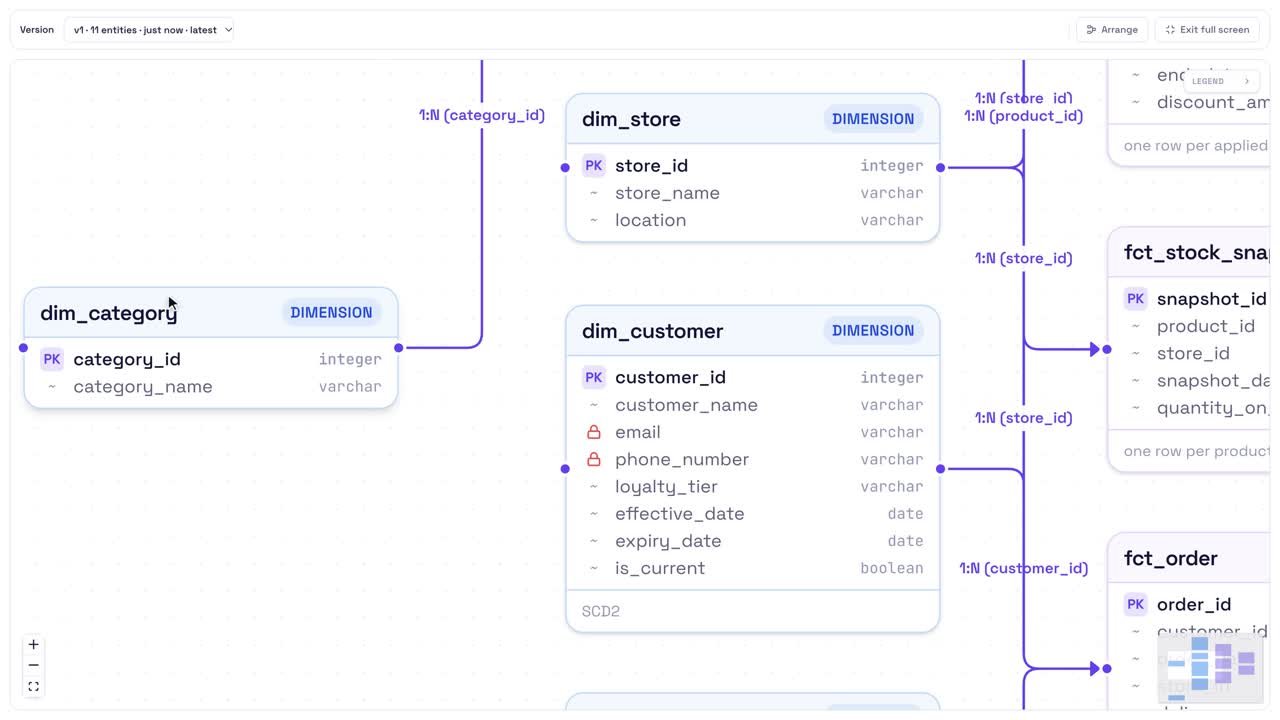
A validated ERD generated by offdataai, with SCD2 history and PII flags
- 01
Search for data modeling tools, or data modelling tools if you write in British English, and you get a list that mixes very different products.
- 02
Some draw diagrams, some manage enterprise model repositories, some write transformation code, and a new group generates the model itself.
- 03
Picking well starts with knowing which job you are hiring the tool for.
- 04
Traditional desktop modelers such as erwin Data Modeler, ER/Studio and SAP PowerDesigner have been the standard for decades.
- 05
They manage conceptual, logical and physical models, support naming standards and model repositories, and fit organizations with an established modeling practice.
- 06
They are usually desktop-installed and centred on the model rather than on cloud-warehouse code such as dbt.
- 07
Diagram tools such as dbdiagram, Lucidchart and draw.io are quick and collaborative for sketching an ERD in a design review.
- 08
They are drawing tools first, so validation, platform-specific DDL and keeping the diagram in sync with the warehouse are usually left to you.
- 09
Code-first tools such as dbt and SQLMesh model the transformations themselves as version-controlled SQL in the warehouse.
- 10
They are the backbone of modern analytics engineering, but they assume you already know what the target model should be.
- 11
AI-native platforms such as offdataai start one step earlier.
- 12
You describe the business in plain English, pick one of 174 templates, draw on a canvas or connect an existing database. offdataai produces a validated Kimball, Data Vault 2.0 or 3NF model, then generates platform-native DDL for eight platforms, a complete dbt project, seed data, docs and migrations.
- 13
On top of the model it builds a business ontology, a semantic layer and an MCP server, so AI agents can use the same definitions as your analysts.
The code it writes, not a sketch
This is the shape of what offdataai generates here, straight from the validated model. Copy it, download it, or push it to Git.
- Four ways to start
- Validated before it is generated
- Real warehouse code
1# Choosing a data modeling tool2#3# Need Category that fits4# ───────────────────────────────────── ───────────────────────────5# Enterprise logical/physical models, Desktop modelers6# long-standing governance process (erwin, ER/Studio, PowerDesigner)7# Quick diagram for a design review Diagram tools8# (dbdiagram, Lucidchart, draw.io)9# Transformations as version-controlled Code-first10# SQL in the warehouse (dbt, SQLMesh)11# Model → DDL → dbt → semantic layer AI-native platform12# from a description, template, (offdataai)13# canvas or existing database
Why teams choose offdataai over other data modeling tools
Four ways to start
A plain-English AI interview, 174 templates across 18+ industries, a drag-and-drop canvas, or reverse-engineering a live database.
Validated before it is generated
Every model is checked for referential integrity, keys and type coercions before any DDL or dbt is written, so the output runs.
Real warehouse code
Platform-native DDL for Snowflake, BigQuery, Databricks, Redshift, Postgres, Synapse, Fabric and DuckDB, plus a dbt project that passes dbt build.
Three methodologies
Kimball star schemas, Data Vault 2.0 and 3NF from the same workflow, with SCD2 history, surrogate keys and hash keys handled for you.
Bring your erwin models
Import erwin XML exports, get a model health report, and convert them for a cloud platform without starting again.
Built for AI agents
An ontology, semantic layer, data catalog and MCP server on top of the model, so agents query with approved definitions.
0
Validated templates
0
SQL targets
0
Modeling paradigms
0+
Industries covered
Native output for the warehouses you already run
 RedshiftPostgreSQL
 Synapse
 FabricDuckDB
 dbtSnowflakeBigQueryDatabricksRedshiftPostgreSQLSynapseFabricDuckDBdbt
Frequently asked questions
What are data modeling tools?
What are the main types of data modeling tools?
What is the best data modeling tool?
How is offdataai different from erwin or ER/Studio?
Does offdataai replace dbt?
Which modeling methodologies does offdataai support?
Which databases and warehouses are supported?
Can a data modeling tool help AI agents?
How much does offdataai cost?
Explore offdataai
- AI data modeling toolDesign a data model from a plain-English description.
- erwin alternativeA browser-based alternative to erwin Data Modeler.
- Best AI data modeling tools in 2026An honest comparison of AI data modeling tools.
- Semantic layerGoverned metrics, compiled to SQL for people and AI agents.
- Context layer for AI agentsConcepts, metrics, join paths and docs for agents over MCP.
- Data catalogEvery table and column, which concepts use it, where it's copied.
Part of the offdataai platform
From business requirements to production-ready data architecture and AI-ready enterprise context.
- 01DesignLogical, physical and dimensional models.
- 02GenerateSQL, dbt, documentation and migrations.
- 03DefineBusiness metrics, semantic models and ontology.
- 04ConnectReal warehouse schemas and metadata.
- 05GovernDrift, lineage, impact analysis and approvals.
- 06ActivateMake trusted context available to AI agents.
This page covers Design. Every stage works on the same model, so what you design here carries through to the rest.
From requirements to AI-ready context, in one platform.
Describe your business in a conversation, start from a template or connect your own database. Your first model is ready in minutes.