
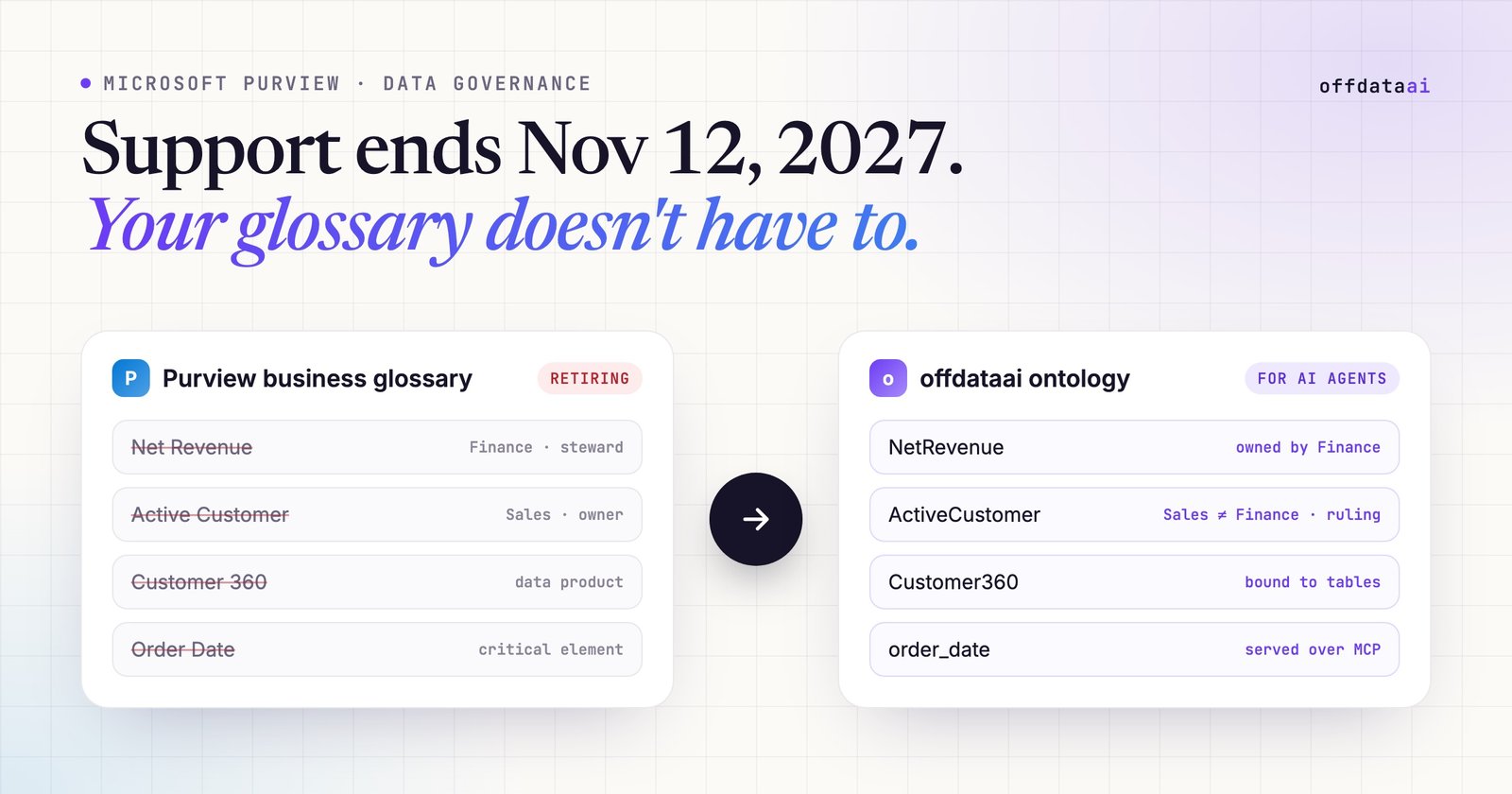
On November 12, 2026, Microsoft announced that Purview Data Governance will be retired, with support ending on November 12, 2027. Governance of the data estate moves to Microsoft Fabric and its OneLake catalog. Purview continues, but it now focuses on data security and compliance.
If your company spent the last few years building a business glossary in Purview, you have twelve months to decide where that work goes. This article covers what Microsoft said, what it didn't say, and how to migrate your Purview glossary before the deadline.
What Microsoft announced about Purview Data Governance
The announcement is a post on the Microsoft Security Community Blog: A next step in the evolution of the Microsoft Data Governance strategy (November 12, 2026). In short:
- The date. Support for Purview Data Governance ends on November 12, 2027.
- Purview stays, with a narrower job. Purview keeps classifying, labelling and protecting sensitive data, preventing data loss across the estate and AI, and helping with compliance. It keeps integrating with Microsoft 365, Azure and Fabric.
- Fabric becomes the governance home. Microsoft describes the OneLake catalog as the single foundation for governing data across the estate. It covers discovery, governance, and security and protection. It reaches Azure and third-party data through shortcuts, mirroring and connectors, and it shows up in Teams, Excel and Foundry. Governance is included in Fabric capacity instead of separate meters.
- Choice of governance tools. Microsoft says Fabric integrates with partners including Atlan, Alation, Collibra and Informatica, so customers can choose the governance tools that fit. In other words, Microsoft expects many customers to pair Fabric with a specialist tool, and specialist tools beyond that list, such as offdataai, can take on the parts Purview leaves behind.
- Regulated customers should talk to Microsoft early. Customers with contractual obligations, or in highly regulated industries, are asked to contact their account team so their situation can be assessed individually.
Microsoft links to further reading from the post: OneLake catalog: the trusted catalog for organizations worldwide, the Microsoft Fabric roadmap and Get started with Microsoft Fabric.
What happens to your Purview glossary and data products?
The post does not go feature by feature. It doesn't say what happens to the specific things teams built in Purview's governance experience (the Unified Catalog): business domains, glossary terms, data products, critical data elements, and the owners and stewards assigned to them. It also doesn't link to a migration tool for them.
That gap matters, because those items are not metadata a scanner can rebuild. A scanner can rediscover your tables. It cannot rediscover that Finance defines Net Revenue as revenue after returns and credits, that Priya in Finance owns that definition, or that the Customer 360 data product depends on six specific critical data elements. People wrote that down, often over many workshops. It's the part of the investment worth carrying forward.
Until Microsoft publishes detailed guidance, confirm the specifics for your tenant with your Microsoft account team.
Four questions to answer before November 2027
1. What do we actually have? Export or list your glossary terms, data products and critical data elements, with their status. Expect a lot of drafts and expired terms. Retirement is a good moment to stop carrying terms nobody approved.
2. Who owns each definition? In Purview, governance domains and contacts (owners, experts, stewards) record who is accountable. Keep that ownership. A definition without an owner goes stale fast.
3. Where do definitions disagree? Glossaries built domain by domain often hold the same word with two meanings. Active customer in Sales is rarely active customer in Finance. A migration is the cheapest moment to find these conflicts and decide which one applies where.
4. Who will read the definitions next? In 2024 the answer was people browsing a catalog. In 2027 it's also AI agents writing SQL against your warehouse. An agent that doesn't know your definition of revenue will invent one. Your glossary should be readable by both.
How to migrate your Purview glossary
The OneLake catalog is Microsoft's answer for discovery, access and protection inside the Microsoft estate, and for many teams it's the right place for that. But a glossary only pays off when its definitions are attached to the data and used when questions are answered. That is the job of a semantic layer, or what is increasingly called a context layer for AI.
That's the gap offdataai fills. It isn't one of the partners Microsoft named, and it doesn't replace the OneLake catalog. It works next to it: Fabric keeps discovery, permissions and protection, and offdataai keeps what your data means, who owns each definition, and how AI agents should use it. You can bring a Purview glossary in directly:
- Connect your Purview tenant, or upload a CSV export. The live connection reads the Unified Catalog (or the classic data map) with an Entra app registration you create. It is read-only and touches metadata only. The CSV route works from Purview's own glossary export.
- Terms become concepts in an ontology. Definitions, acronyms, synonyms, related terms and references come along. Expired terms are skipped and drafts are flagged.
- Domains become owning teams. Each governance domain becomes the team that owns its definitions, with the owner or steward's name and email, and Purview recorded as the authoritative source.
- Data products keep their parts. Data products become concepts, and their critical data elements become their fields.
- Nothing lands unreviewed. Every imported item arrives as a proposal. You preview the import first, and nothing already in your ontology is overwritten.
Once the glossary is in, it stops being a reference document and becomes an ontology. You bind concepts to the real tables in Databricks, Snowflake, BigQuery or Postgres, settle conflicting definitions with an explicit ruling, release versions, and serve it all to AI agents through an MCP server under access rules. It also exports to open formats (Apache Ossie, OWL, JSON-LD, dbt MetricFlow YAML, Snowflake semantic views and Databricks metric views), so you never face a forced migration like this one again.
If you're weighing a catalog such as Atlan as well, our comparison explains where each one fits.
A Purview migration timeline
| When | What to do |
|---|---|
| Now to Q1 2027 | Inventory terms, data products and owners. Clean out drafts and expired terms. Talk to your Microsoft account team if you are regulated. |
| Q1 to Q2 2027 | Import the glossary into its new home. Resolve conflicting definitions and confirm owners. |
| Q2 to Q3 2027 | Bind definitions to warehouse tables and test them with real questions, from people and from AI agents. |
| Before Nov 12, 2027 | Switch consumers over, and keep an export of the Purview glossary as a record. |
Frequently asked questions
When does Microsoft Purview Data Governance support end?
Support ends on November 12, 2027. Microsoft announced the retirement on November 12, 2026.
Is Microsoft Purview being discontinued?
No. Purview continues, focused on data security and compliance: classifying, labelling and protecting sensitive data, data loss prevention and compliance. Only the data governance part is retiring.
What replaces Purview Data Governance?
Microsoft points customers to the OneLake catalog in Microsoft Fabric, and says Fabric integrates with governance partners so customers can choose the tools that fit.
Can I export my Purview glossary?
Yes. Purview can export glossary terms to CSV, and its APIs expose terms, data products and critical data elements. offdataai can import either: a CSV export, or a live, read-only connection to your Purview tenant.
Will Purview glossary owners and domains carry over?
In offdataai, yes. Each governance domain becomes the team that owns its definitions, and owners and stewards are kept with their names and emails.
The bottom line
Purview isn't going away. Its data governance experience is. The tables will still be in your warehouse in 2028, but the definitions your teams wrote down will only survive if you move them on purpose.
Start with the part that's hardest to recreate: the meaning, and who owns it. See how offdataai imports a Purview glossary, or try it with a CSV export.