
A data catalog that knows what your tables mean
Every system, table and column you connect, which business concepts use them and where the same data lives twice. Built from metadata only, searchable by your team and by AI agents.
- From $1/month
- 8 SQL targets
- 174 templates
Suggested relationships
See it in action
A narrated walkthrough, recorded in the real app.
Three steps, minutes not months
Describe or import
Answer a short interview, open a template, draw on the canvas or connect a live database.
Review a validated model
Keys, grain, history and PII are checked before any code is written. Refine it in plain English.
Ship and keep it current
Native DDL, dbt, seeds, docs and an ontology. Push to Git, diff versions, generate migrations.
Why teams choose offdataai
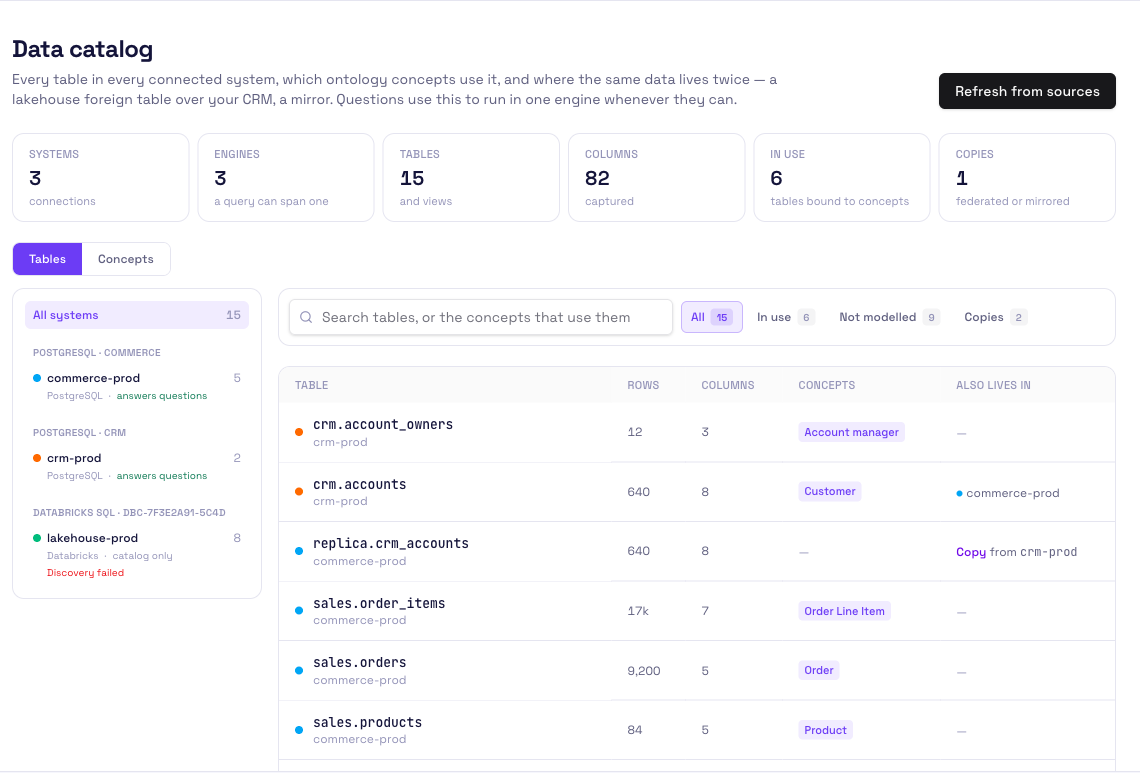
Connected systems in the catalog, with tables classified and keys suggested
- 01
Most data catalogs answer one question well: what tables do we have?
- 02
The harder questions come next.
- 03
Which of the three customer tables is the real one?
- 04
Which dashboards and metrics depend on this column before I rename it?
- 05
Is this field personal data?
- 06
And now, for AI agents: which table should I query to answer this question at all?
- 07
offdataai's data catalog is built for those follow-up questions because it is connected to the rest of your data model.
- 08
It gathers every system, table and column from your connections: PostgreSQL, MySQL, Snowflake, BigQuery, Amazon Redshift, Databricks Unity Catalog, including foreign catalogs federated through Lakehouse Federation, and HubSpot.
- 09
It then indexes which ontology concepts are bound to each table and column.
- 10
"Who uses this column?" becomes a lookup instead of a hunt through code.
- 11
It also spots duplication.
- 12
When a Postgres table is mirrored into a lakehouse, the catalog links the copy to its original, so you can see where the same data lives twice and the semantic layer can choose the cheapest copy to query.
- 13
All of this comes from metadata: names, types, keys and comments.
- 14
The catalog never reads a row of your data.
- 15
The catalog is one part of a connected stack rather than a separate product to roll out.
- 16
The ontology gives tables business meaning, the semantic layer turns questions into SQL, and the MCP server lets agents search the catalog with
search_catalogbefore they query anything. - 17
For data modelling teams, that means the inventory, the meaning and the governed access live in one place.
The code it writes, not a sketch
This is the shape of what offdataai generates here, straight from the validated model. Copy it, download it, or push it to Git.
- Every connected system
- Who uses this column?
- Copies linked to originals
1// search_catalog("customer email")2{3 "results": [4 {5 "system": "Snowflake · acme_prod",6 "table": "ANALYTICS.SALES.DIM_CUSTOMER",7 "column": "EMAIL",8 "type": "VARCHAR",9 "classification": "PII · masked (hash)",10 "used_by": ["Customer.email (ontology: acme-sales)"]11 },12 {13 "system": "Postgres · crm",14 "table": "public.contacts",15 "column": "email_address",16 "copy_of": null,17 "used_by": ["Customer.email (ontology: acme-sales)"]18 },19 {20 "system": "Databricks · lakehouse",21 "table": "crm_mirror.public.contacts",22 "copy_of": "Postgres · crm · public.contacts"23 }24 ]25}
What the data catalog does
Every connected system
Postgres, MySQL, Snowflake, BigQuery, Redshift, Databricks Unity Catalog and HubSpot, down to column types, keys and comments.
Who uses this column?
Each table and column shows the ontology concepts bound to it, so impact analysis before a rename or drop is a lookup, not a guess.
Copies linked to originals
Tables mirrored or federated into another system are linked back to their source, showing where data is duplicated and which copy to query.
Metadata only
Built from catalog metadata and cheap discovery calls. The catalog never reads your rows, so connecting a system is low-risk.
Searchable by agents
AI agents call search_catalog over MCP or the API to find the right table before asking a governed question through the ontology.
Governance on Pro
PII classification and masking, compliance tags, lineage, and write-back of reviewed descriptions and tags to Unity Catalog.
0
Validated templates
0
SQL targets
0
Modeling paradigms
0+
Industries covered
Native output for the warehouses you already run
 RedshiftPostgreSQL
 Synapse
 FabricDuckDB
 dbtSnowflakeBigQueryDatabricksRedshiftPostgreSQLSynapseFabricDuckDBdbt
Frequently asked questions
What is a data catalog?
What does offdataai's data catalog contain?
Does the catalog read my data?
How does it find duplicated data?
Is this a replacement for an enterprise data catalog like Collibra or Alation?
How do AI agents use the catalog?
Does the catalog handle PII and governance?
What is the difference between a data catalog, a semantic layer and an ontology?
Which plan includes the data catalog?
Explore offdataai
- Semantic layerGoverned metrics, compiled to SQL for people and AI agents.
- Context layer for AI agentsConcepts, metrics, join paths and docs for agents over MCP.
- Data modeling tools comparedDesktop, diagram, code-first and AI-native tools side by side.
- Ontology builderTurn a data model into a published business ontology.
- MCP server for AI agentsGive Claude and other agents your tables, joins and metrics.
- Model BuilderDrag-and-drop data modeling on a full-screen canvas.
Part of the offdataai platform
From business requirements to production-ready data architecture and AI-ready enterprise context.
- 01DesignLogical, physical and dimensional models.
- 02GenerateSQL, dbt, documentation and migrations.
- 03DefineBusiness metrics, semantic models and ontology.
- 04ConnectReal warehouse schemas and metadata.
- 05GovernDrift, lineage, impact analysis and approvals.
- 06ActivateMake trusted context available to AI agents.
This page covers Connect and Govern. Every stage works on the same model, so what you design here carries through to the rest.
From requirements to AI-ready context, in one platform.
Describe your business in a conversation, start from a template or connect your own database. Your first model is ready in minutes.