
A semantic layer your AI agents and analysts can trust
Define concepts, relations and metrics once, bound to your real tables. offdataai compiles every question into SQL from those definitions, so a dashboard, an analyst and an AI agent all get the same number.
- From $1/month
- 8 SQL targets
- 174 templates
See it in action
A narrated walkthrough, recorded in the real app.
Three steps, minutes not months
Describe or import
Answer a short interview, open a template, draw on the canvas or connect a live database.
Review a validated model
Keys, grain, history and PII are checked before any code is written. Refine it in plain English.
Ship and keep it current
Native DDL, dbt, seeds, docs and an ontology. Push to Git, diff versions, generate migrations.
Why teams choose offdataai
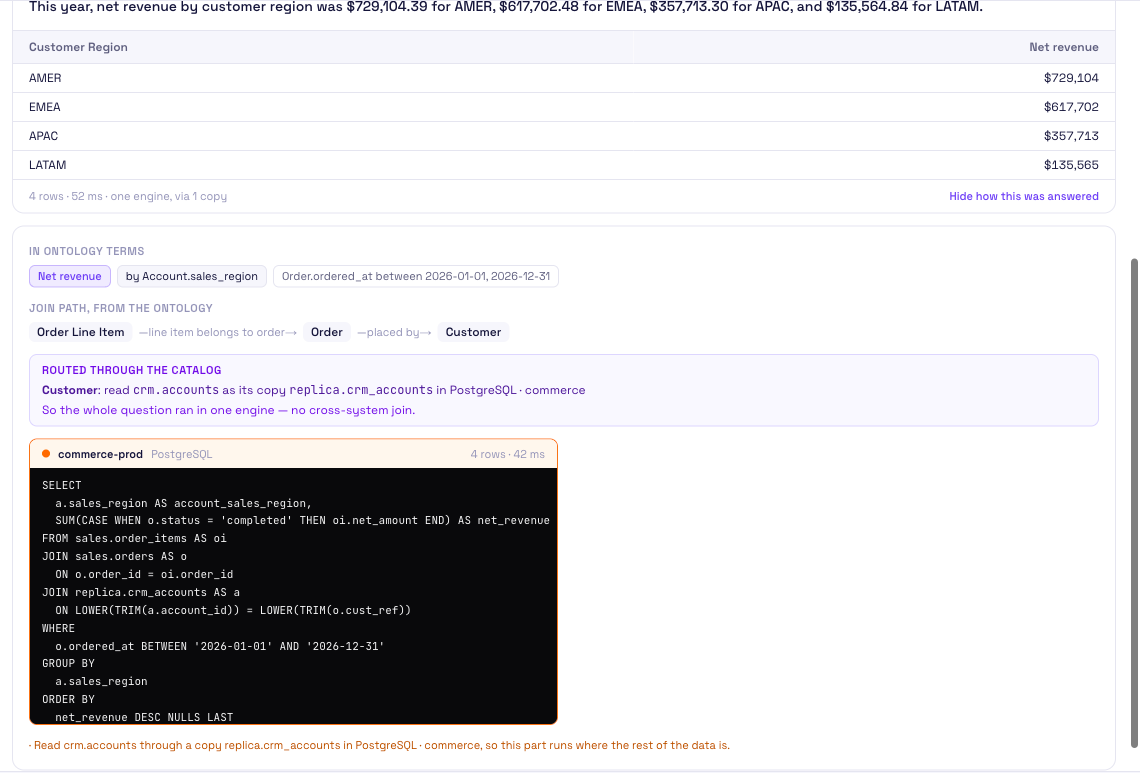
A business question compiled from governed metrics, with the join path and the SQL that ran
- 01
Every data team has the same quiet problem: three people asked for revenue last quarter and got three different numbers.
- 02
One joined order lines twice, one forgot refunds, one used the wrong date column.
- 03
A semantic layer fixes that by writing the definition down once, in business terms, and generating the SQL from it every time.
- 04
With AI agents now asking questions of the warehouse directly, that shared definition has stopped being a nice-to-have.
- 05
An agent with only a schema will guess, and it will guess confidently.
- 06
offdataai's semantic layer is built from your data model, not typed into a
YAMLfile from memory. - 07
Its concepts, relations and metrics are derived from a project created by the AI interview, one of 174 templates, the Model Builder or a live database read by the Database Modeler.
- 08
Each concept stays bound to the tables and columns that store it.
- 09
Semantic modelling becomes a review task rather than a blank page: you accept, edit or reject what was derived, and the published ontology contains only what your team approved.
- 10
When someone asks a question, the language model's only job is to choose the metrics, dimensions and filters by name.
- 11
A deterministic compiler does the rest.
- 12
It walks the relations to find the join path, applies the metric formula and writes dialect-correct SQL for each source system.
- 13
If a question spans two systems, offdataai pushes down what each one can run and joins the results in memory.
- 14
The answer comes back as a sentence, the rows and the exact SQL, so nothing is a black box.
- 15
The same layer serves people and machines.
- 16
Analysts ask in plain English in the app.
- 17
Agents such as Claude connect through the built-in MCP server or the
REST APIwith a scoped API key, under the ontology's access rules, row filters and PII masking. - 18
On Databricks you can also publish the definitions as a Unity Catalog metric view so Genie reads governed metrics too.
- 19
Pair it with the data catalog to see which tables each concept uses, and the context layer to give agents everything they need in one call.
The code it writes, not a sketch
This is the shape of what offdataai generates here, straight from the validated model. Copy it, download it, or push it to Git.
- Metrics defined once
- Compiled, never guessed
- Across systems
1// A structured question, named by concept — not by table2{3 "metrics": ["Net revenue"],4 "dimensions": ["Customer.segment", "Order.order_month"],5 "filters": [{ "field": "Order.order_month", "op": ">=", "value": "2026-01" }]6}78-- What the compiler emits for Snowflake, walking9-- Order → placedBy → Customer through the bindings10SELECT c.segment,11 DATE_TRUNC('month', o.order_date) AS order_month,12 SUM(ol.amount - ol.discount) AS net_revenue13FROM sales.fct_order_line ol14JOIN sales.fct_order o ON o.order_id = ol.order_id15JOIN sales.dim_customer c ON c.customer_sk = o.customer_sk16WHERE DATE_TRUNC('month', o.order_date) >= '2026-01-01'17GROUP BY 1, 2;
What the semantic layer does
Metrics defined once
Net revenue, active customers or churn are written once against concepts, with their formula and grain, and reused by every question, dashboard and agent.
Compiled, never guessed
The model selects metrics and fields by name; a compiler walks relations and bindings to write the SQL. Approved definitions decide the joins, not a prompt.
Across systems
Questions that span Snowflake, Postgres, BigQuery, Redshift or Databricks are pushed down per source and federated in memory when they can't run as one statement.
Answers you can audit
Every answer includes the rows and the SQL that ran, and every agent query is logged, so a number can always be traced back to its definition.
Governed access for agents
Access rules and row filters apply to API and MCP questions, and personal data stays masked unless the key carries the pii:read scope.
Open standards
Export the semantic model as OWL Turtle, JSON-LD or RDF/XML, publish resolvable IRIs, and push Databricks metric views to Unity Catalog.
0
Validated templates
0
SQL targets
0
Modeling paradigms
0+
Industries covered
Native output for the warehouses you already run
 RedshiftPostgreSQL
 Synapse
 FabricDuckDB
 dbtSnowflakeBigQueryDatabricksRedshiftPostgreSQLSynapseFabricDuckDBdbt
Frequently asked questions
What is a semantic layer?
What is semantic modeling (semantic modelling)?
How is offdataai's semantic layer different from asking an LLM to write SQL?
Can one question span more than one database?
What does an answer look like?
How does the semantic layer control what agents can see?
Does it work with Databricks Unity Catalog metric views?
Is this a metrics layer or a semantic layer?
Where does the semantic model come from?
Which plan includes the semantic layer?
Explore offdataai
- Context layer for AI agentsConcepts, metrics, join paths and docs for agents over MCP.
- Data catalogEvery table and column, which concepts use it, where it's copied.
- Data modeling tools comparedDesktop, diagram, code-first and AI-native tools side by side.
- Ontology builderTurn a data model into a published business ontology.
- MCP server for AI agentsGive Claude and other agents your tables, joins and metrics.
- Model BuilderDrag-and-drop data modeling on a full-screen canvas.
Part of the offdataai platform
From business requirements to production-ready data architecture and AI-ready enterprise context.
- 01DesignLogical, physical and dimensional models.
- 02GenerateSQL, dbt, documentation and migrations.
- 03DefineBusiness metrics, semantic models and ontology.
- 04ConnectReal warehouse schemas and metadata.
- 05GovernDrift, lineage, impact analysis and approvals.
- 06ActivateMake trusted context available to AI agents.
This page covers Define and Activate. Every stage works on the same model, so what you design here carries through to the rest.
From requirements to AI-ready context, in one platform.
Describe your business in a conversation, start from a template or connect your own database. Your first model is ready in minutes.