
Datensen and offdataai — desktop design or warehouse platform
Datensen makes desktop modelers for relational, document and GraphQL databases. offdataai is a browser platform for analytics: it designs warehouse models from a description or a template, generates the code, and serves the meaning to AI agents. Here is an honest comparison.
- From $1/month
- 8 SQL targets
- 174 templates
1$ describe "Online store: orders, products, customers, returns"23interview 5 questions · grain, history, cardinality4model kimball · 2 facts · 5 dimensions · SCD2 on Customer5review keys, grain, joins, personal data → passed67generated8 ddl/snowflake.sql dbt/ docs/data_model.md9ontology Net revenue · Return rate · Active customer10serve mcp · rest api · claude connector
Datensen and offdataai, compared
| Datensen | offdataai | |
|---|---|---|
| Products | Luna Modeler (relational), Moon Modeler (MongoDB and document databases), Galaxy Modeler (GraphQL), plus free Merit and Meteor Modelers | One platform: data models, DDL, dbt projects, an ontology and a semantic layer, and agent access over MCP |
| Where it runs | Desktop app for Windows, macOS and Linux | In the browser, with a Claude connector, an MCP server and a REST API |
| Databases | PostgreSQL, Oracle, SQL Server and Azure SQL, MySQL, MariaDB, SQLite, Supabase, Neon and ODBC/JDBC sources; MongoDB, Cosmos DB and DocumentDB in Moon Modeler | Snowflake, Databricks, BigQuery, Redshift, Postgres, Synapse, Microsoft Fabric and DuckDB; reads live schemas from Postgres, MySQL, Snowflake, BigQuery, Redshift and Databricks |
| Starting a model | Design on the diagram, or reverse engineer an existing database | Describe the business to an AI interview, open one of 174 templates, use the Model Builder canvas, read a live schema, or import erwin, DDL, dbt YAML, JSON Schema, CSV and XLSX |
| Analytics modelling | General relational and document schema design | Kimball star schemas, Data Vault 2.0 and 3NF, with grain, keys and history (SCD) checked before code is generated |
| Code generated | DDL and ALTER scripts in the database's dialect; $jsonSchema validation scripts; GraphQL schemas | Warehouse DDL, a complete dbt project, migrations between versions, seed data and documentation |
| Business meaning and AI | Not described | An ontology of concepts, relations and metrics, a semantic layer, and MCP access for AI agents under access rules and PII masking |
| Pricing | Perpetual licences, for example Luna Modeler from $99 | Monthly plans from $1, published on the pricing page |
When offdataai fits your team
Choose offdataai when
- You are building an analytics warehouse on Snowflake, Databricks, BigQuery, Redshift, Fabric, Synapse, Postgres or DuckDB.
- You want to start from a plain-English description or one of 174 templates, with grain, keys and history checked before code is generated.
- You need a dbt project, migrations, an ontology and governed access for AI agents, not only DDL.
Bring a model across with DDL
Export DDL from Luna Modeler or read the live database, import it into offdataai, and add the warehouse layer, the ontology and MCP serving without redrawing the model.
See it in action
A narrated walkthrough, recorded in the real app.
Three steps, minutes not months
Describe or import
Answer a short interview, open a template, draw on the canvas or connect a live database.
Review a validated model
Keys, grain, history and PII are checked before any code is written. Refine it in plain English.
Ship and keep it current
Native DDL, dbt, seeds, docs and an ontology. Push to Git, diff versions, generate migrations.
Why teams choose offdataai
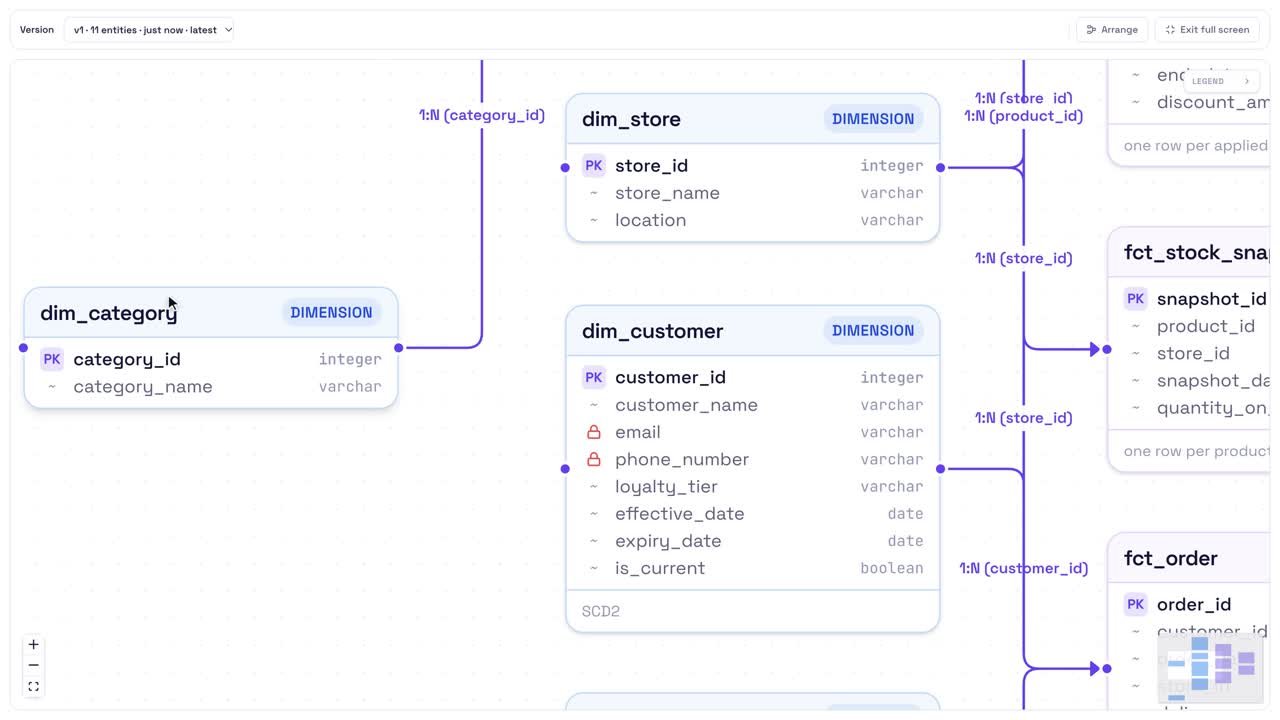
A validated ERD: keys, SCD2 history and PII flags on every table
- 01
Datensen's modelers are focused desktop tools for designing a database schema and keeping it in sync with the database: reverse engineering, dialect-specific scripts, comparison with a live database and reports.
- 02
offdataai is aimed at analytics teams.
- 03
It starts from the business, through an AI interview or a validated template, and produces a warehouse model with its DDL, dbt project and documentation.
- 04
The model's concepts and metrics become an ontology and semantic layer that AI agents can query over MCP, under access rules.
What offdataai does differently
Design from a description
Describe the business and get a Kimball, Data Vault 2.0 or 3NF model, or start from 174 validated templates.
Checked before generated
Grain, keys, relationships, history and personal data are reviewed before any SQL is written.
Warehouse-native code
DDL for eight cloud and local warehouses, a complete dbt project, migrations and seed data.
Meaning, not only structure
Concepts, relations and metrics derived from the model, reviewed by your team and released in versions.
Agents under access rules
MCP and API access with row filters and PII masking, with every query logged.
Works in Claude
The Claude connector lets you build and review models from a chat, on the plan you already have.
0
Validated templates
0
SQL targets
0
Modeling paradigms
0+
Industries covered
Generates native SQL and dbt for 8 platforms · connects live to Snowflake, Databricks, BigQuery, Redshift and Postgres
 RedshiftPostgreSQL
 Synapse
 FabricDuckDB
 dbtSnowflakeBigQueryDatabricksRedshiftPostgreSQLSynapseFabricDuckDBdbt
Frequently asked questions
Is offdataai a Datensen alternative?
What does Datensen make?
Which is cheaper?
Can I bring an existing database model into offdataai?
Does offdataai work offline?
More comparisons
- Atlan vs offdataaiAtlan builds context from the assets you already have. offdataai captures meaning when the model is designed, validates it and serves it to agents.
- SqlDBM vs offdataaiBoth are cloud modelers. offdataai starts from a conversation or a template and treats meaning, validation and agent access as the core, in open formats.
- Databricks Unity Catalog vs offdataaiUnity Catalog metric views are a strong home for meaning inside Databricks. offdataai keeps the definitions platform-neutral and publishes them to Databricks too.
- dbt Semantic Layer vs offdataaidbt is where transformations and metrics-as-code live. offdataai designs the model and its meaning upstream, then hands dbt a project and an Apache Ossie semantic model.
- Power BI semantic models vs offdataaiPower BI semantic models serve Power BI reports well. offdataai keeps business definitions outside any one BI tool, for every agent and warehouse.
- All comparisonsCatalogs, modelers, warehouse semantics and BI models, side by side.
- Data modeling tools comparedDesktop, diagram, code-first and AI-native tools side by side.
Part of the offdataai platform
The business context behind accurate AI answers, built from the data model up.
- 01DesignLogical, physical and dimensional models.
- 02GenerateSQL, dbt, documentation and migrations.
- 03DefineBusiness metrics, semantic models and ontology.
- 04ConnectReal warehouse schemas and metadata.
- 05GovernDrift, impact analysis, tests and approvals.
- 06ActivateMake trusted context available to AI agents.
This page covers Generate and Connect. Every stage works on the same model, so what you design here carries through to the rest.
Give your AI agents context they can trust.
Design the model, define what your metrics mean, and serve that context to every agent and BI tool, on the warehouse you already run.
Datensen, Luna Modeler, Moon Modeler and Galaxy Modeler are trademarks of their owner. offdataai is not affiliated with or endorsed by Datensen. Comparison based on Datensen's public website as of November 2026.